
Content Layout File Editor
Adding a content layout file to the project and setting its BuildAction to ContentLayout allows you to specify the conceptual content topics that will be included in the help file and define their layout in the table of contents.
The Content Layout Editor Window
You can edit the content layout file from within the help file builder by double-clicking it in the Project Explorer window or by selecting the Open option from its context menu. The content layout editor window is shown below.
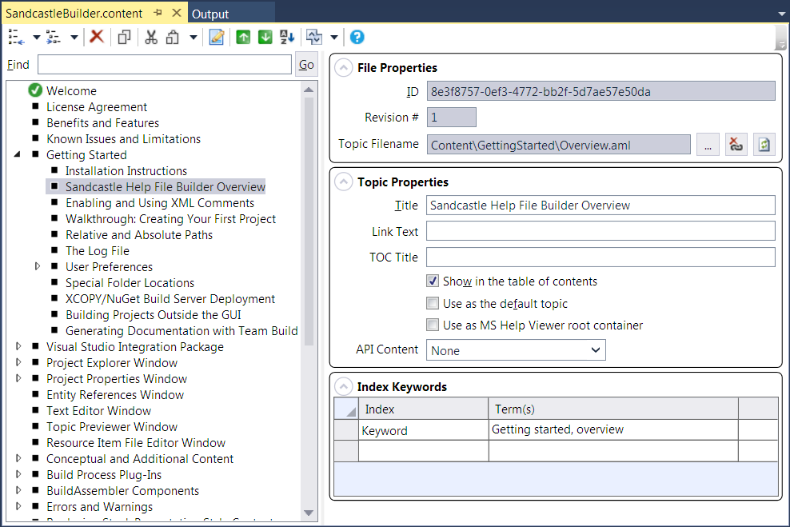
The left side of the window shows the table of contents as it is currently defined in the file. Entries can be arranged hierarchically to any number of levels. The right side of the window shows the properties for the currently selected topic. You can modify the topic's details at any time. Changes are stored automatically before moving off to another topic in the tree. The content layout file identifies conceptual content topics by their unique ID rather than by filename. As such, you are free to rearrange the topic files in the Project Explorer as you see fit and even change their filenames. As long as you do not change the topic's unique ID, it will be correctly associated with its entry in the content layout file. See the Topic Files topic for a description of each of the topic file properties and how they are used.
The Find textbox allows you to search for a topic by ID, display name, or filename. Enter some text to find and hit Enter or click the Go button to start the search. Hit Enter or click Go again to find subsequent matches. Matches are found by doing a case-insensitive search of the topic IDs, display names, and filenames.
The tree supports drag and drop to re-order the topics. Simply click and hold the left mouse button on a topic and then drag it to its new location. When you drop it on a topic, it is inserted immediately after the target item. If you hold down the Shift key while dropping an item, it will become a child of the target item.
Available Commands
The toolbar above the tree is used to perform various actions on the content layout file such as adding new topics, deleting topics, rearranging them, etc. These options are also available in a context menu accessed by right clicking on a topic in the tree. The commands (from left to right) and their associated context menu options perform the following actions:
- Add Sibling Topic
This will add a new topic at the same level as the currently selected topic. The sub-options for this command allow you to add a new topic file based on a template, add an existing topic file, add all topic files from an existing folder, or add an empty container node.
- Add Child Topic
- This will add a new topic as a child of the currently selected topic. The sub-options for this command allow you to add a new topic file from a template, add an existing topic file, add all topic files from an existing folder, or add an empty container node. The notes from above for sibling topics apply to these commands as well.
- Delete
Delete the selected topic and all of its sub-topics.
- Copy as Topic Link
- Copy a link to the topic to the clipboard. If pasted into a Markdown or MAML file, a link element is inserted that will link to the selected topic.
- Cut
- Cut the selected topic and its sub-topics to the clipboard. A copy of the topic is made and it is then removed from the tree.
- Paste
- If a topic has been cut to the clipboard, you can click the Paste button to add it to the tree. If you just click the button, the topic is added as a sibling of the currently selected topic immediately following it. If you select the Paste as Child sub-option, the topic is inserted as a child of the selected topic.
- Edit File
- Edit the selected content file. Double-clicking a topic in the tree will also open it for editing.
- Move Up
- This will move the selected topic up in the order of topics at the same level as the selected topic. Note that moving a topic will also move its sub-topics. Sub-topics will still remain in their given order below the parent topic.
- Move Down
- This will move the selected topic down in the order of topics at the same level as the selected topic. Note that moving a topic will also move its sub-topics. Sub-topics will still remain in their given order below the parent topic.
- Sort Topics
- Sort the topics alphabetically by title within the currently selected topic's group.
- Convert to Markdown
- This command only appears on the context menu when you right click on a topic. It is only enabled if the topic is a MAML file. Selecting this command will convert the MAML topic file to a Markdown topic file. The converted file will replace the MAML file in the project and the content layout file. A backup copy of the original MAML file is created with a .aml.bak extension in case you want to revert to it later. See the Converting MAML Topics To Markdown topic for more information.
- Expand/Collapse Options
- This command contains a set of options that lets you expand or collapse all topics in the tree or just the sub-topics for the selected topic. When the file is saved, the expanded/collapsed state is saved along with the last selected topic making it easy to return to the spot you stopped editing the file when it was last opened. This information is also used by the Entity References Window to make it easy to find the current topic when using it to insert topic references into other topic files.
- Help
- Open this help topic in the help file.
Keyboard Shortcuts
The following keyboard shortcuts can also be used in the content tree to execute the various commands:
- Context Menu Key - Display the context menu.
- Delete - Delete the selected topic.
- Ctrl+Up - Move the selected topic up within its group.
- Ctrl+Down - Move the selected topic down within its group.
- Ctrl+C - Copy a link to the selected topic to the clipboard. Performing a paste operation in a text editor window will insert a link to the copied topic.
- Ctrl+X or Shift+Delete - Cut the selected topic to the clipboard.
- Ctrl+V or Shift+Insert - Paste the topic on the clipboard as a sibling of the selected topic.
- Ctrl+Shift+V or Ctrl+Shift+Insert - Paste the topic on the clipboard as a child of the selected topic.
- Ctrl+E - Edit the selected topic.
- Ctrl+Shift+T - Sort the topics at the same level as the selected topic alphabetically.
See Also
Other Resources
Conceptual Content
Topic Files